The UK Manager Confidence Gap
What 100 Managers Told Us About Leading Under Pressure

What 100 Managers Told Us About Leading Under Pressure
Before building Claryence, we needed to understand what actually holds UK managers back. Not theory. Not assumptions. Real data.
So we surveyed 100 frontline and middle managers across four high-pressure sectors - Finance & Insurance, Health & Social Care, Hospitality, and Retail - where people management challenges hit hardest. These are industries with acute staff turnover, low engagement, and managers caught in the daily grind of human friction.
The results reveal a stark truth that makes intuitive sense: technical expertise gets you promoted, but people skills make or break you as a manager.
And right now, 41% struggle with conflict. 41% find it difficult balancing workload with leading their teams. 34% struggle to keep people motivated.
Robust research backs-up our findings.
The Twin Pressure Points
When we asked managers to identify their biggest challenges, two issues dominated everything else:
Managing conflict or tricky team dynamics: 40.7%
Balancing workload and people management: 40.7%
These aren't knowledge gaps - they’re confidence gaps. Managers know what they should do. They freeze when they need to actually do it.
This aligns precisely with what Harvard Business School's Dr Linda Hill documented in her longitudinal study of new managers. Hill found that the transition from individual contributor to manager isn't incremental - it’s transformational. It requires a complete identity shift from "doing the work" to "ensuring the work gets done through others."
But here's the problem: Around 82% of UK managers have no formal management or leadership training(CMI/YouGov). Most new UK managers report receiving little or no formal leadership training in their early months in role, with surveys suggesting around 80%–85% lack any structured preparation. We're creating what researchers call "accidental managers” - people promoted for technical excellence, then left to figure out leadership on their own.
The result? Research widely attributed to Gartner suggests around 60% of new managers fail within their first 24 months in role.
What Managers Actually Struggle With
Our survey revealed seven core challenges, ranked by how many managers cited each one:
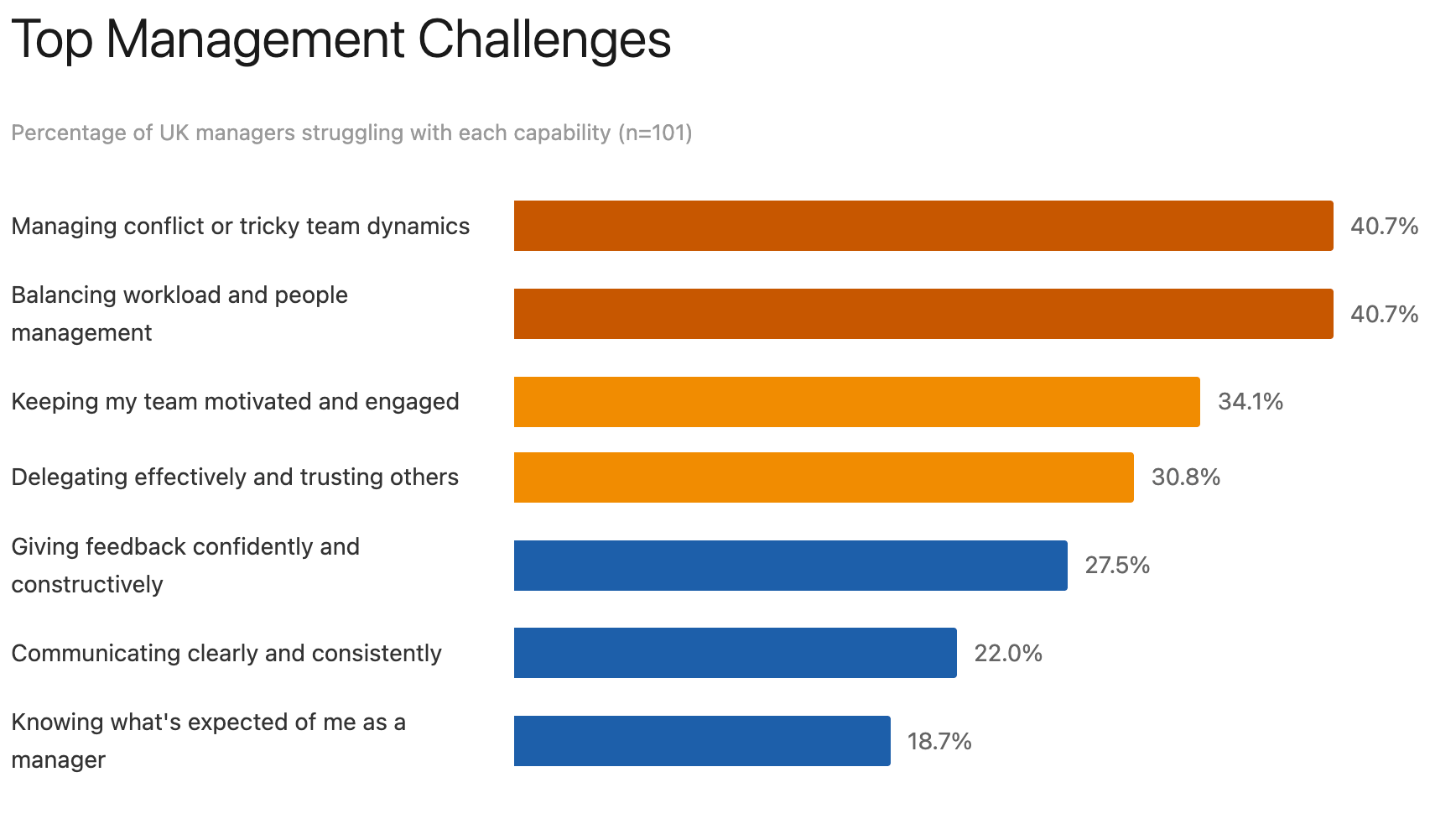
Source: Claryence Manager Confidence Survey, January 2026
Look at what's missing from this list: technical skills, industry knowledge, analytical capability. Every single challenge is about people.
This matches decades of research from Gallup showing that manager quality accounts for 70% of variance in team engagement scores. It's not what managers know about the business—it's how they handle human dynamics under pressure.
The Career Stage Pattern
When we broke down the data by age, distinct patterns emerged:
Early-career managers (25-34) struggle most with:
- Role clarity (43%)
- Delegation (43%)
- Motivation (43%)
They're still transitioning from "doing" to "leading." They know how to deliver work themselves; they don't yet trust others to do it.
Mid-career managers (35-44) face different pressures:
- Conflict (40%)
- Feedback (37%)
- Workload (29%)
They're caught in the middle - managing upward and downward simultaneously, dealing with relationship tensions in both directions.
Late-career managers (45-54) battle overwhelm:
- Workload (52%)
- Motivation (48%)
- Conflict (41%)
The strain is no longer about knowing how - it’s about sustaining energy. Michael Watkins' research on leadership transitions shows that managers who achieve role clarity within their first 90 days are substantially more likely to succeed than those who remain unclear about their fundamental purpose. But our data suggests that clarity erodes over time if managers don't actively maintain it.
The Sector Story: Different Industries, Same Human Challenge
Financial & Insurance: 63% cite workload balance
Compliance and performance demands leave little room for people development. These managers live in a world of relentless output pressure, where coaching conversations feel like luxuries they can't afford.
Health & Social Care: 55% struggle with conflict
High emotional labour and constant interpersonal friction on shift. Understaffing, burnout, and the intensity of care work make conflict the daily norm rather than the exception.
Research on the Thomas-Kilmann Conflict Mode Instrument shows that most new managers default to avoidance strategies when facing interpersonal conflict, despite evidence that early intervention produces superior outcomes. In healthcare, that avoidance can be dangerous.
Hotels & Restaurants: 60% cite motivation as primary concern
Constant rebuilding of culture amid high turnover and transient teams. Google's Project Aristotle - which analysed 180 teams - found that psychological safety was the strongest predictor of team effectiveness. But how do you build psychological safety when your team composition changes every few months?
Retail: 47% face conflict management challenges
Frontline emotion tested in real-time with staff and customers daily. These managers handle the hardest conversations on the shop floor, in public, with no time to prepare.
Yet despite these different manifestations, the underlying dynamic is universal: technical competence doesn't translate to people leadership.
Three Core Truths About UK Managers
1. They know what to do—but freeze under pressure
UK managers aren't short on knowledge. They're short on confidence in applying it. When conflict emerges or workload spikes, they default to firefighting and avoidance.
Kluger and DeNisi's meta-analysis of 131 feedback studies found that well-structured feedback can move performance from the 50th percentile to the 66th percentile - a substantial improvement. But poorly delivered feedback can decrease performance substantially.
The gap isn't in understanding the principles - it’s in the muscle memory needed to execute them under stress.
2. Career stage determines the confidence gap
Different career stages reveal distinct pressure points. Early-career managers struggle with delegation and role clarity. Mid-career managers face feedback and conflict tensions. Late-career managers battle overwhelm.
Research from the Institute for Corporate Productivity links stronger delegation cultures with meaningfully higher revenue growth and more promotable employees. Yet our survey shows 31% of managers - rising to 43% among those aged 25-34 - struggle with delegation.
Why? Three psychological barriers: perfectionism ("no one can do it as well as I can"), speed bias ("it's faster if I do it myself"), and control anxiety ("I'm responsible for outcomes").
3. Human friction defines success across all sectors
Whether it's conflict in healthcare (55%), motivation in hospitality (60%), or workload in finance (63%), the core challenge remains consistent: managing people under pressure.
Harvard's Amy Edmondson identifies specific behaviours that build psychological safety - admitting mistakes, asking for feedback, modelling curiosity, celebrating learning from failures. Teams whose managers exhibit these behaviours consistently score substantially higher on innovation and quality measures.
But psychological safety is fragile. MIT research shows that team culture forms within the first 90 days of team interaction. Teams whose managers actively shape culture during formation phase maintain stable, positive dynamics substantially longer than teams where culture develops organically.
What This Means for Management Development
Millions are promoted into management roles each year, yet only a minority receive robust preparation; UK surveys indicate that formal post‑promotion support is available to fewer than one in five new managers.
The financial implications cascade through recruitment costs, training replacement managers, lost productivity, and damaged team morale. Studies calculate that workplace conflict alone costs organisations hundreds of billions annually in paid hours.
Yet when organisations implement comprehensive development programmes addressing core management capabilities, the results can be transformative: in one organisation’s programme, development investments delivered a 40% improvement in 18‑month new‑manager retention, a 35% faster time‑to‑competence, a 28% uplift in engagement, and a 4.2:1 ROI within 18 months (Claryence Client Data).
The future of management development isn't more theory - it’s more practice. Managers don't need another course on "leadership fundamentals” - they need safe spaces to practice difficult conversations, experiment with delegation, and build muscle memory for high-pressure moments.
Research by Martin Seligman shows that resilience represents a learnable skill set rather than fixed personality trait, with structured interventions improving resilience scores substantially within six months. Liz Wiseman's work on "multiplier" versus "diminisher" managers reveals that multipliers achieve substantially higher performance from their teams and develop significantly more promotable employees.
These aren't innate talents. They're capabilities that can be systematically developed.
The Confidence Gap in One Sentence
UK managers are expected to lead, but rarely taught how to do so confidently.
Our survey of 101 managers confirms what decades of research has shown: the transition from technical expert to people leader requires deliberate development, not accidental promotion. The challenges managers face - conflict, workload, motivation, delegation, feedback, communication, role clarity - aren’t mysteries. They're well-documented, well-researched, and most importantly, solvable.
The question isn't whether managers can develop these capabilities. The research proves they can. The question is whether organisations will invest in systematic development that gives new leaders the tools they need to succeed from day one.
That's the confidence gap Claryence is built to close - one micro-practice at a time.
Methodology: Survey conducted January 2026. Sample: 101 UK frontline and middle managers across Financial Services & Insurance, Health & Social Care, Hospitality (Hotels & Restaurants), and Retail. Response distribution: 25-34 years (28%), 35-44 years (42%), 45-54 years (27%). Margin of error ±9.7% at 95% confidence level.
Key Research Sources:
- Hill, L. A. (2003). Becoming a Manager: How New Managers Master the Challenges of Leadership
- Edmondson, A. (2018). The Fearless Organization: Creating Psychological Safety in the Workplace
- Watkins, M. (2013). The First 90 Days: Proven Strategies for Getting Up to Speed Faster and Smarter
- Kluger, A. N., & DeNisi, A. (1996). The effects of feedback interventions on performance. Psychological Bulletin
- Seligman, M. E. P. (2009). Building resilience. Harvard Business Review, 87(4), 100–106.
- Wiseman, L. (2017). Multipliers: How the Best Leaders Make Everyone Smarter
- Gallup Organization - Employee engagement and management effectiveness research
- Google's Project Aristotle - Team effectiveness research
- CEB/Gartner - Manager failure rate research
- Chartered Institute of Personnel and Development (CIPD) - UK management studies