AI Simulations: The New Frontier in Skill Development
From flight decks to feedback sessions, AI is democratising experiential learning
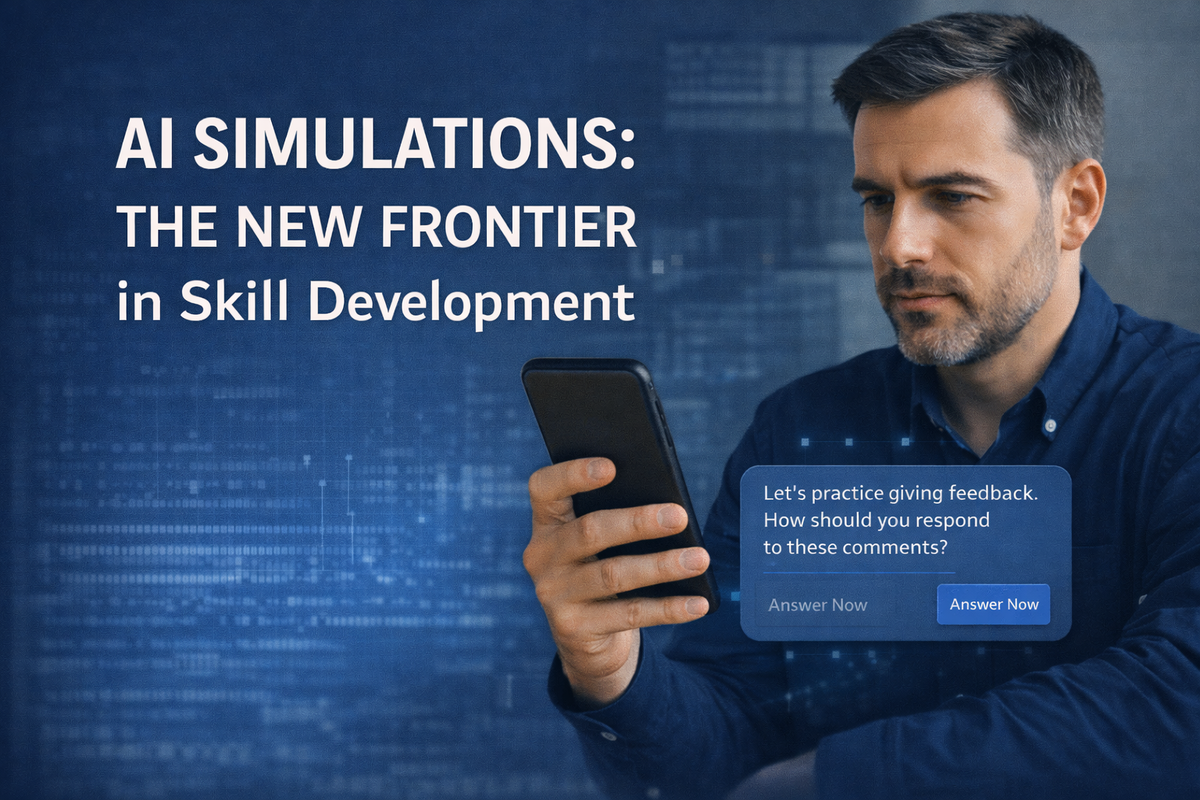
From flight decks to feedback sessions, AI is democratising experiential learning
For years, the most effective form of learning has been hiding in plain sight: practice.
Pilots rehearse emergency procedures long before take-off. Surgeons refine their technique on virtual patients before stepping into theatre. Formula 1 drivers spend hours in simulators before hitting the track.
Each relies on one principle — learning by doing — because no amount of theory substitutes for experience.
Until recently, though, this kind of experiential learning was reserved for high-stakes, high-budget sectors. For everyone else — from sales and customer service to management — "practice" meant a role play, a workshop, or a PowerPoint case study that couldn't match the complexity of real life.
That's changing fast.
The rise of AI-powered simulation
Artificial intelligence is quietly revolutionising how people learn at work.
Platforms like SecondBody, Didask, and Cornerstone use generative AI to simulate human interactions — not through scripts, but through natural, emotionally intelligent conversation. Learners can practise handling objections, managing conflict, or giving feedback to a virtual person who listens, reacts, and adapts in real time.
One friend's 23 year old son recently told me about using AI simulations at his workplace, a builder's merchant, to improve his customer service and sales skills. His "coach" could detect tone, emotion and phrasing, and give instant, specific feedback on what worked — and what didn't. He found the learning process both engaging and effective.
So, it's no longer science fiction. It's already happening.
From hardware to humanity
Traditionally, simulation meant physical equipment: flight simulators, mannequins, mission control centres. AI has changed that.
Now, what's being simulated isn't the environment — it's the human element. The conversation, the decision, the emotion.
AI has effectively democratised simulation, turning something once hardware-intensive and expensive into something accessible and adaptive — capable of recreating complex interpersonal moments across any profession.
Formula 1 logic, human context
Formula 1 provides a powerful analogy. Drivers spend countless hours in simulators, replaying the same corners under different conditions until every reaction becomes instinctive.
That's not so different from how a manager can develop their capability. Whether it's running a one-to-one, managing performance, or navigating conflict, realistic repetition builds clarity and confidence.
With AI, this kind of practice no longer requires a facilitator, a training room, or a big budget — just curiosity and commitment.
What makes this so powerful
AI-driven simulations offer a combination traditional training rarely achieves:
- Scalability – everyone can access realistic practice, not just a select few.
- Personalisation – feedback is contextual, behavioural and instant.
- Continuity – learning becomes a loop, not a one-off event.
- Safety – mistakes become part of the process, not something to fear.
It's the same logic behind why pilots train in simulators — and why managers should, too.
Beyond technical skill
The most exciting impact is on soft skills — the interpersonal capabilities that define effective teamwork and people management.
AI can now interpret emotion, tone and empathy, creating "virtual colleagues" or "clients" who respond dynamically. Learners can practise influencing, handling conflict, or delivering tough feedback with the realism that makes learning stick.
As Didask's CEO Philippe Lacour notes:
"AI allows us to create pedagogical scenarios that adapt not only to what learners say, but how they say it. That emotional layer turns information into transformation."
The democratisation of experience
This is where Claryence aligns strongly.
For too long, experiential learning has been the preserve of large corporates who can afford bespoke platforms and executive coaches. Our mission at Claryence is to democratise experience-based learning — bringing the benefits of realistic, repeatable practice to every new manager, regardless of company size or budget.
Our Claryence Learning Loop — Assess, Practice, Apply, Reflect, Refine — is built on that very idea. At its heart sits AI-powered practice: short, adaptive simulations that replicate the real challenges managers face daily.
It's about turning learning from a passive event into an active process — one where capability grows through doing, reflecting, and refining.
The future of skill development
AI isn't replacing the human side of learning. It's enhancing it.
By combining behavioural science with accessible technology, we can help more people learn the way experts always have — through realistic, iterative practice that builds confidence and competence.
Just as flight simulators transformed aviation safety, AI simulations are poised to transform how we develop managers, leaders and customer-facing teams.
The future of learning isn't just about what you know. It's about how you practise.