From Confidence to Capability
Why management development so often fails to change anything - and what actually works
Why management development so often fails to change anything - and what actually works
Think of a manager you have invested in and watched not quite develop. Someone you believed in - promoted, perhaps, or given deliberate stretch. You provided support, sent them on training, had the conversations. A year on, the same issues are present. The difficult conversations are still being avoided. The decisions that should be theirs are still landing on your desk.
This is not an unusual experience. Across care homes and hospitality businesses, professional services firms and retail operations, the same pattern recurs. And it is almost never the manager's fault in the simple sense. Most managers want to develop. Most are trying. The problem is that the conditions for genuine capability development were not in place - and good intention, from either side, won't substitute for them.
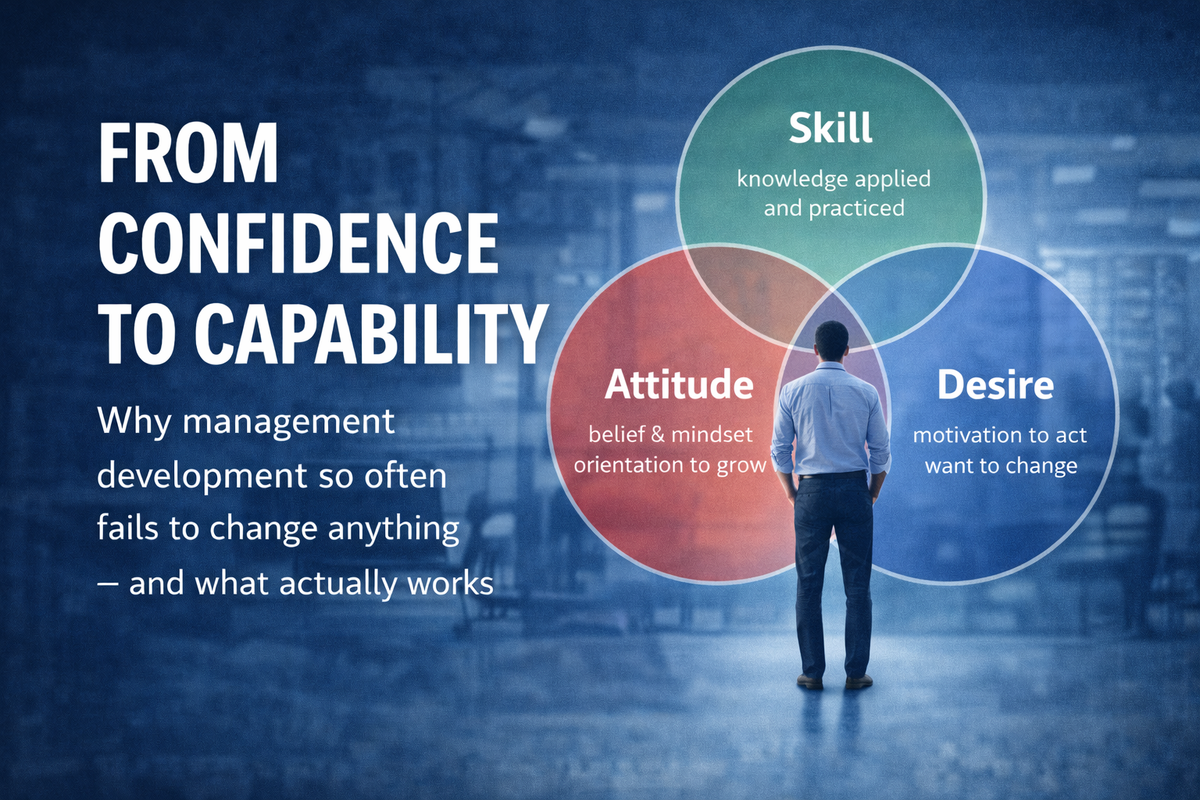
The Model: Three conditions, one outcome.
Most management development focuses on one thing: what managers know and can do. That matters. But knowledge and skill, on their own, are not enough. Two other conditions are equally necessary - and their absence is why development most often fails to take hold.
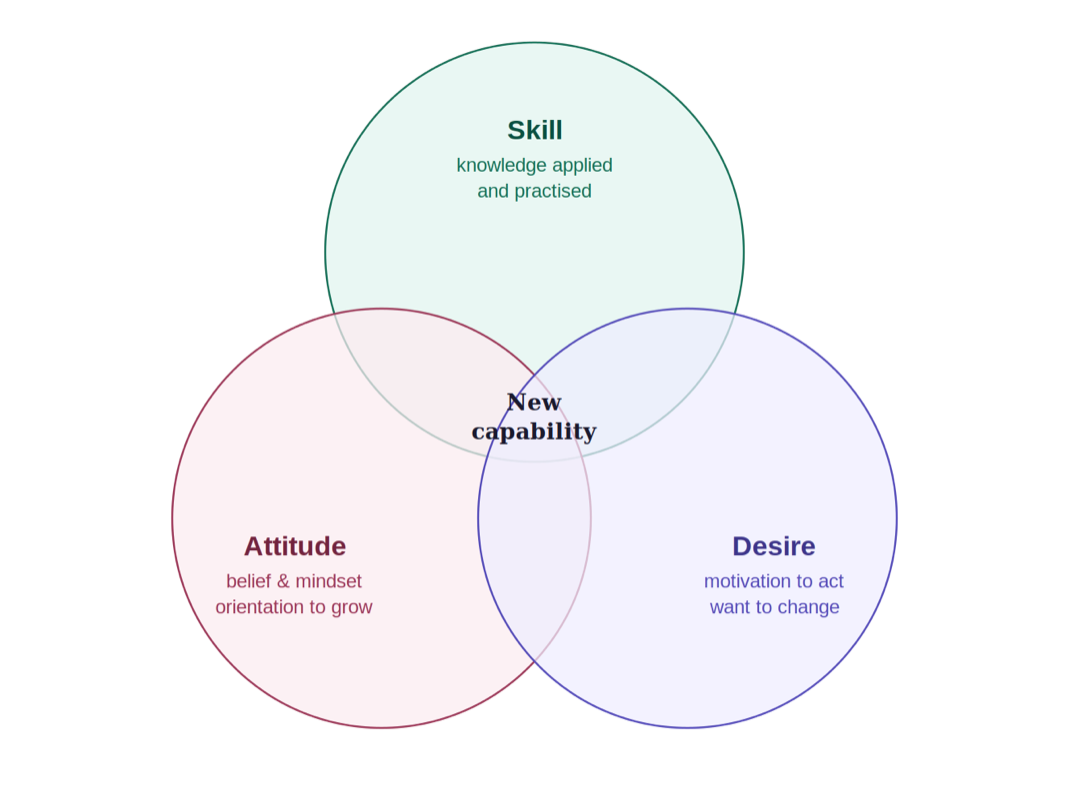
Attitude is the orientation a manager brings to the prospect of changing. Not their mood or their workshop enthusiasm - something deeper. Do they believe they are capable of developing? Do they believe their current approach has room for improvement? A manager with a closed Attitude will absorb training without being changed by it.
Desire is motivation toward this specific change - not general ambition, but appetite for the particular development being asked of them right now. It is personal, tied to identity and values, and easy to undermine without meaning to.
Skill is the practical capacity to do the thing. Here precision matters: knowledge - knowing what good management looks like - is not the same as skill. Knowledge is the raw material. Skill is what knowledge becomes when it has been applied in real conditions, reflected on honestly, and practised again. Most training develops knowledge. Very little creates the conditions for knowledge to become skill.
Knowledge is what you have after a good training day. Skill is what you have after you've done the difficult thing enough times that it becomes reliable.
When all three are genuinely in place, something emerges at their intersection: grounded confidence - earned through experience, specific to what a manager has actually managed to do. That confidence is what makes capability self-reinforcing. It expands what the manager is willing to attempt, which creates more practice, which builds more skill. The loop, once started, tends to accelerate.
Five Managers: What the patterns look like in practice
The five managers below are fictitious composites. Their situations are not. Each represents a pattern that recurs across sectors. Understanding which pattern applies to a manager changes what you do about it.
Marcus · Operations Manager, food manufacturing - The Capable Bystander
Marcus has run the same production floor for twelve years. His numbers are consistently good. The business owner has sent him on management development programmes twice, with limited effect. In sessions Marcus is professionally engaged. But when conversations move toward how he manages his people, he becomes present in body and absent in substance.
His team's turnover tells the story his performance data doesn't. People respect Marcus. Very few feel they can raise a problem with him. The best of his team leads have started moving on.
Marcus has real skill as an operator. What he lacks is the Attitude or Desire to develop as a people leader. His identity is built on operational mastery, and the suggestion that his management of people needs work registers as threat rather than feedback. His confidence as an operator has quietly colonised his self-assessment as a manager - nothing in twelve years has clearly required him to separate the two.
More programme content won't move him. What shifts things is consequence he cannot rationalise away: a facilitated process that surfaces team engagement data and turnover costs alongside a direct conversation about operational succession risk. For the first time he sees the cost in terms that matter to him. The development conversation that follows isn't about leadership theory. It's about what the operation needs to be capable of when he isn't there.
Nadia · Deputy Manager, residential care home - The Willing But Stuck
Nadia was promoted eighteen months ago. Her registered manager saw exactly what she was hoping for: warmth, commitment, genuine investment in residents and team. Nadia attends every piece of development on offer, engages fully, and can reflect perceptively on her own practice.
But the same issues keep appearing. She won't challenge the two long-serving care workers who cut corners. Her one-to-ones rarely get beneath the surface. When a difficult staffing situation arose, she froze and deferred to her manager. Her confidence fluctuates sharply - high after a good week, fragile after any real pressure.
Nadia has everything the model asks for except built skill in the specific things she finds hardest. Her confidence is resting on positive feedback and aspiration rather than on a foundation of having done the difficult thing. It cannot hold its ground when tested because there isn't enough underneath it yet.
She doesn't need more knowledge or more encouragement. She needs structured practice on her specific development edges - accountability conversations, managing long-tenured staff, holding her ground - with honest feedback on the actual behaviour, not just the intention. The turning point comes when she handles a difficult conversation with one of the long-serving care workers. She had prepared for it, rehearsed a version of it. The real conversation was harder. But it worked. That specific memory becomes the anchor everything else is built on.
Dominic · New General Manager, hospitality group — promoted from top performer - The Motivated but Misaligned
Dominic was the obvious promotion - three consecutive years as the group's best front-of-house manager, universally liked. Six months into the general manager role, his area director is not sure what she is seeing. He works with visible intensity, is over-prepared for every conversation, and gives technically correct feedback with an anxious edge that makes it land badly. He tells his coach he's not sure he is cut out for this.
Dominic has genuine Desire and growing Skill. What hasn't caught up is his Attitude - specifically, his belief that he is capable of this role. The confidence he had as a front-of-house manager was real and calibrated to that context. As a general manager he is performing confidence he doesn't yet feel. The intensity is covering the gap.
The most important intervention is not more skill development. It is normalisation - not hollow reassurance, but evidence that what he is experiencing is what the transition from excellent individual contributor to new manager almost always feels like. His coach works with him to identify specific moments where his instincts have already worked - genuine leadership he has discounted because it doesn't feel as clean as his previous successes. When his Attitude finds a more secure foundation, the intensity decreases and the quality of his management improves noticeably. He stops performing and starts leading.
Yvonne · Practice Manager, GP surgery - eleven years in the role - The Reluctant Expert
Yvonne is highly capable, operationally excellent, and fiercely loyal to the practice. When ICB funding became available for a programme focused on team empowerment and distributed leadership, the lead GP nominated her immediately. Yvonne engaged professionally throughout. Her reflections were thoughtful. Nothing changed.
Yvonne is not developing because she doesn't believe the development is pointing in the right direction. She can produce the behaviours the programme asks for when observed. But her Desire to genuinely adopt them is absent, because her management philosophy was built over a decade in a pressured clinical environment where high-control, directive leadership kept things safe. She is not resistant. She has a different, internally coherent view of what good management looks like - and the programme hasn't yet given her a reason she finds compelling to revise it.
What moves her is not leadership theory but patient safety data. A coach with a primary care background introduces research on psychological safety, error reporting, and patient outcomes. The development goal is reframed around something she actually values: whether creating more space for staff to raise concerns might improve safety rather than compromise it. Her Desire, previously withheld, becomes genuinely available. The development that follows is hers rather than performed.
Rohan · Senior Account Manager, professional services - fast-tracked, high potential - The Emerging Leader
Rohan has been identified as a future partner. His client skills are exceptional. He takes development seriously and asks good questions about his own leadership. His managing partner describes him as one of the most promising people in the pipeline. What the firm hasn't reckoned with is the gap between the pace of his progression and the pace of his actual capability development.
He has been given team leadership responsibilities that consistently exceed where he currently is - not by a manageable stretch but a significant one. He manages it through technical excellence and long hours. His team is functional. It is not being led. He knows this. His confidence, from the inside, is borrowed against expectations he hasn't yet fully met.
Two things happen simultaneously. The firm agrees to slow the pace of his progression - not to withdraw confidence, but to create space that is stretching rather than overwhelming. And a structured development programme gives him a practice environment for the specific capabilities he has been managing around. The confidence that builds is different in quality from what came before: grounded in specific evidence of things he has done and been tested by. He stops managing the gap and starts closing it.
Confidence: The signal that tells you whether it's working
Look across these five managers and one thing runs through all of them: confidence, and whether it is grounded in what they can actually do.
Marcus's confidence has colonised territory where his capability hasn't followed. Nadia's is genuine but fragile, resting on aspiration rather than built foundation. Dominic is performing confidence he doesn't yet feel. Yvonne's is deep but belongs to a frame she hasn't revised. Rohan knows his is borrowed - and that knowledge is simultaneously his greatest asset and his most persistent source of anxiety.
What each of them needs is not more confidence in the general sense. They need a more accurate relationship between their confidence and what they can actually do. And the only route to that is through experience that is real enough to be informative, reflection that is honest enough to learn from, and practice that is repeated enough to build something that holds.
What managers need is not more confidence. They need a more accurate relationship between their confidence and what they can actually do.
Confidence earned this way is diagnostic as well as motivational. When it is specific, grounded, and calibrated to actual capability, it is the best indicator available that development is genuinely taking hold. When it is inflated, fragile, or performed, something in the conditions is off. Learning to read that signal - in others and in yourself - is one of the most practically useful things this model offers.
The Claryence Approach: Developing managers where it counts
Claryence is built around the conviction that management capability only develops when the right conditions are in place - and that most conventional training works on only one of them at a time.
If you own or run a business and are trying to develop a manager who hasn't quite grown into their role - understanding which condition is missing changes everything. Someone whose Attitude is closed needs a different conversation from someone whose Desire is misaligned. Someone who is Willing But Stuck needs structured practice, not more inspiration.
If you work in HR or L&D, the five archetypes give you a diagnostic language for a conversation that is often frustratingly vague. 'They're not engaging with development' is a description. Which condition is missing is a diagnosis. The interventions are different. The design of the development is different.
And if you are a manager who recognised yourself somewhere in these pages - the most likely barrier is not knowledge. You probably know more than enough about what good management looks like. It is the gap between knowing and being able to do it reliably, in the moments that count.
Closing that gap requires practice that is real enough to matter and reflection that is honest enough to learn from. That is what Claryence is designed to support - through bite-sized role play simulations and facilitated reflection and feedback from our AI coach, Clary.
The most likely barrier is not knowledge. It is the gap between knowing and being able to do it reliably, when it counts.
If any of this resonates - whether you are thinking about a manager in your team, a development programme you are designing, or your own growth - we would be glad to talk.