How Managers Really Learn: On-the-Job, Just-in-Time
Last week I wrote about why traditional training fails new managers. The problem isn't that the content is bad — it's that the methods often don't match the reality of how people actually learn.
So what does effective management development look like? The answer has been hiding in plain sight for decades: people learn best through experience.
My US Education: Where Management is a Real Discipline
Back in the 1990s, I built my first business in the US — a leadership development company using outdoor experiential programmes. What struck me most wasn't the ropes courses themselves, but how differently Americans approached management development.
In the US, management is treated as a legitimate discipline. Universities offer dedicated management degrees. Companies invest systematically in leadership capability. There's an entire infrastructure built around the idea that managing people requires specific skills that can be learned, practised, and mastered.
Compare that to the UK, where management is still often seen as something you "pick up" through experience or common sense. The cultural difference was stark — and it showed in the results.
The Ropes Course Revolution (And What We Got Wrong)
Those outdoor programmes were hugely popular in the 90s. Teams would spend weekends navigating trust falls, rope bridges, and problem-solving challenges in the great outdoors.
Outdoor training has since fallen out of vogue — and not without reason. Too often it slipped into the same traps as classroom workshops: memorable experiences that didn't translate to better management back at work.
But at its best, those programmes worked because they tapped into something fundamental about how humans learn. They followed what David Kolb called the experiential learning cycle:
- Experience – doing something challenging, often for the first time.
- Reflection – thinking about what happened and why.
- Conceptualisation – drawing out lessons and principles.
- Application – testing those insights in the real world.
This is how we naturally learn everything that matters. And it's exactly how managers develop too.
Learning in the Flow of Real Work
Fast forward to today, and the principle hasn't changed — but the setting has. The most effective management learning doesn't happen in conference rooms or online modules. It happens when managers are in the thick of real situations like: giving feedback to a struggling team member for the first time; running their first proper team meeting; navigating a conflict between two colleagues who won't speak to each other.
When learning is timely, contextual, and immediately applicable, it sticks. When it's abstract, delayed, or divorced from real challenges, it simply doesn't.
This is why research consistently shows that the 70:20:10 model remains so influential: 70% of effective learning happens on the job, 20% through social interaction and feedback, and just 10% through formal courses. Yet most organisations still structure their development programmes around that least effective 10%.
From Physical Challenges to Workplace Simulations
While I wouldn't suggest putting every new manager on a ropes course today, the underlying principle of experiential learning remains absolutely vital.
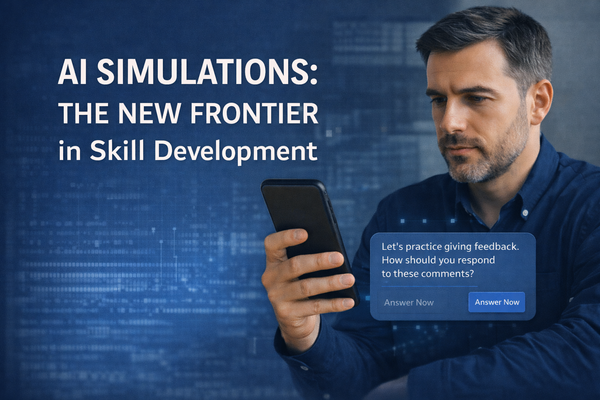
What's changing is how we create those learning experiences. Instead of physical challenges in the woods, we now have access to realistic workplace simulations, AI-driven role-play scenarios, and just-in-time coaching prompts delivered exactly when managers need them most.
The tools have evolved dramatically, but the goal remains the same: to give managers a safe, supported environment where they can practise new skills, reflect on what works, and apply insights — before the stakes get too high in real situations.
Why This Matters for UK Productivity
Here's what I learned from working in both cultures: countries that treat management as a discipline consistently outperform those that don't.
The US approach isn't perfect, but there's something powerful about recognising that leading people requires specific skills that must be developed intentionally. It's not enough to hope good management will emerge naturally from technical expertise or years of experience.
If we want to close the UK's management gap, we need to stop treating leadership development as an optional extra and start treating it as core professional development — delivered in ways that actually work.
The Way Forward: Experience Plus Structure
The solution isn't to abandon all formal training or send everyone back to the woods. It's to combine the power of experiential learning with the systematic approach that treats management as a proper discipline.
That means creating opportunities for managers to practise skills in realistic contexts. Supporting reflection and feedback in the moment when experiences are fresh. Reinforcing lessons through ongoing application rather than one-off events.
This is how new managers build genuine confidence. This is how skills actually stick. And ultimately, this is how businesses can finally unlock the productivity that's been trapped by poor management.
Next week: I'll explore the rise of microlearning in management development — and why bite-sized, practical lessons delivered just-in-time may finally give us a scalable way to make experiential learning part of every manager's journey.
What's your experience? Have you learned more from a challenging real situation than from any formal course? What made those experiences stick when traditional training didn't?