The Rise of Microlearning in Management Development
Managers learn best when lessons are bite-sized, timely and action orientated.
Over the last few weeks, I've written about the UK's "accidental manager" crisis, the £84 billion productivity cost, why traditional training often doesn't work, and how managers really learn — in the flow of work, through experience and practice.
The response has been great, with many of you privately sharing stories of being thrown into management roles without support. So the natural question becomes: what should effective management development actually look like in practice?
One of the most promising answers is microlearning.
What Do We Mean by Microlearning?
Microlearning isn't just another buzzword. It's the recognition that people learn best when lessons are:
Bite-sized – short, practical modules that take minutes, not hours or days. Timely – available at the exact moment of need, not months in advance when they'll be forgotten.
Action-oriented – focused on what to actually say or do in real situations, not abstract theory.
Picture this: a manager is about to give feedback to a struggling team member for the first time. A focused 5-minute module on structuring that conversation, plus a quick chance to practise, is infinitely more useful than a half-day workshop they attended months ago and barely remember.
Why It Actually Works
The research consistently backs this up. Studies in workplace learning show that:
Retention is dramatically higher when lessons are short and applied immediately, according to research published in the Journal of Applied Psychology. Application happens faster because the learning is directly relevant to a live challenge the manager is facing right now. Engagement increases significantly as managers aren't overwhelmed by lengthy courses filled with irrelevant theory.
This perfectly aligns with the 70:20:10 model: 70% of effective learning happens on the job. More importantly, it connects directly to David Kolb's experiential learning cycle that I discussed previously — experience, reflection, conceptualisation, and application.
Microlearning is essentially a way of compressing that cycle into manageable chunks. Instead of waiting months to reflect on a management experience, managers can engage with short lessons that help them make sense of what's happening in real time, then immediately apply those insights.
Why New Managers Need This Most
For experienced leaders, microlearning might feel like a useful refresher. For new managers, it's often the difference between confidence and complete crisis.
The first time you need to run a proper one-to-one, address a performance issue, or delegate a significant task, you don't need a management textbook. You need a simple, structured approach and the chance to rehearse it safely before the stakes get real.
Microlearning provides exactly that bridge: quick, focused knowledge followed by immediate practice. It transforms "I have no idea what to do" into "I know my next step and feel confident taking it."
This is experiential learning made practical and scalable. Rather than sending managers on expensive outdoor courses or waiting for organic experiences to happen, microlearning creates deliberate learning moments that mirror real workplace challenges.
Lessons from Other High-Stakes Fields
We already know microlearning works well in other domains where mistakes have serious consequences:
Healthcare: Surgeons use micro-simulations to practise complex procedures before performing them on patients.
Aviation: Pilots use bite-sized scenario drills to stay sharp between full flight simulations.
Technology: Developers learn new frameworks through small, modular lessons applied directly to their actual code.
Why should management — with equally high stakes for people's careers and business performance — be treated any differently?
The Exciting Future of Manager Development
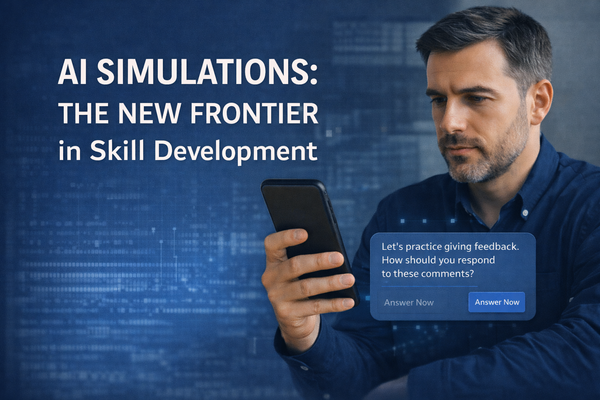
What really excites me is how microlearning can now be paired with AI-enabled coaching and realistic simulation. Imagine a manager about to handle a difficult conflict conversation between team members. They could:
Review a focused 5-minute refresher on framing constructive feedback. Practise the conversation with an AI coach that responds realistically in real time. Receive personalised tips based on their specific approach and communication style.
That's microlearning in action: fast, contextual, confidence-building, and immediately applicable. Crucially, it's also scalable — accessible to SMEs and start-ups, not just large corporates with big training budgets.
The Compound Effect of Small Changes
Here's what I've learned across decades of working with managers: the difference between those who struggle and those who thrive often comes down to just a few simple habits and approaches.
But these habits need to be learned, practised, and reinforced in the moments that actually matter — not in abstract training sessions months before they're needed.
Microlearning isn't the complete solution to Britain's management gap, but it's a powerful building block. Small, consistent lessons compound over time into lasting capability and genuine confidence.
Why This Matters Now
If we're serious about fixing the UK's productivity challenge, we have to stop overwhelming new managers with theory they can't immediately use and start giving them practical support exactly when and where they need it.
The technology now exists to deliver this at scale. The research proves it works. The only question is whether we'll embrace approaches that actually match how people learn, rather than clinging to methods that feel familiar but consistently fail to deliver results.